
How to Plan Marine Lighting Procurement for a New Vessel
Planning marine lighting for a new vessel involves more than choosing individual lamps. The lighting package needs to match the vessel type, operating environment, installation locations, technical specifications, and applicable project requirements.
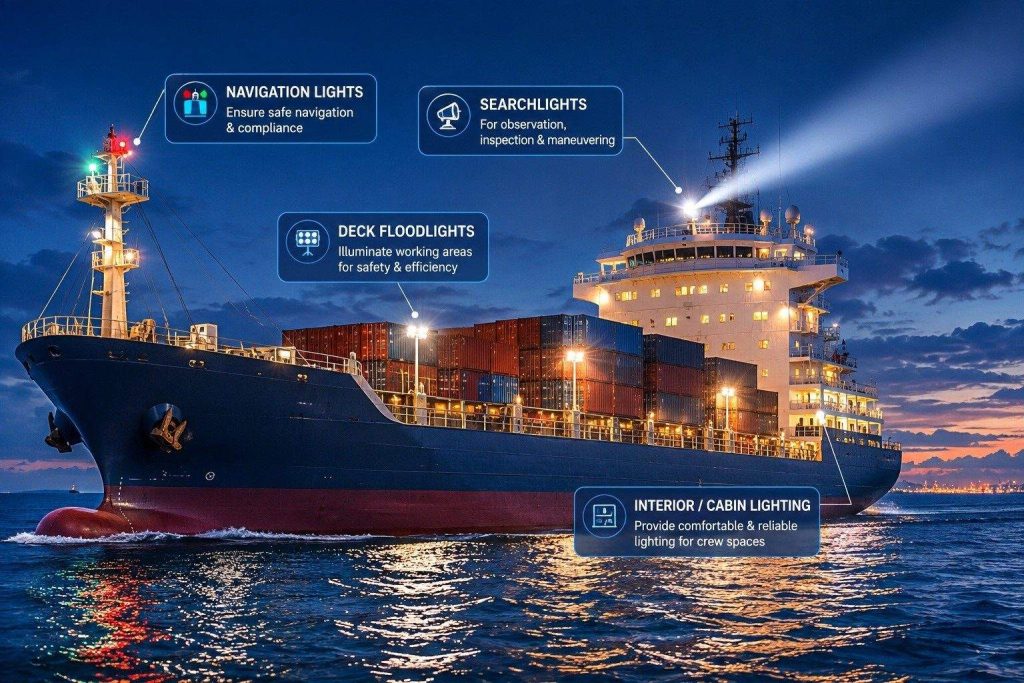
For shipyards, shipowners, marine equipment distributors, and procurement teams, establishing these requirements before requesting quotations can make supplier comparison easier and reduce specification changes during the project.
Table of Contents
Start With the Vessel and Its Operating Environment
Prior to choosing marine lighting systems, it is crucial to establish what type of vessel will be used, in what conditions it will operate, and what types of lighting will be required.
Identify the Vessel Type
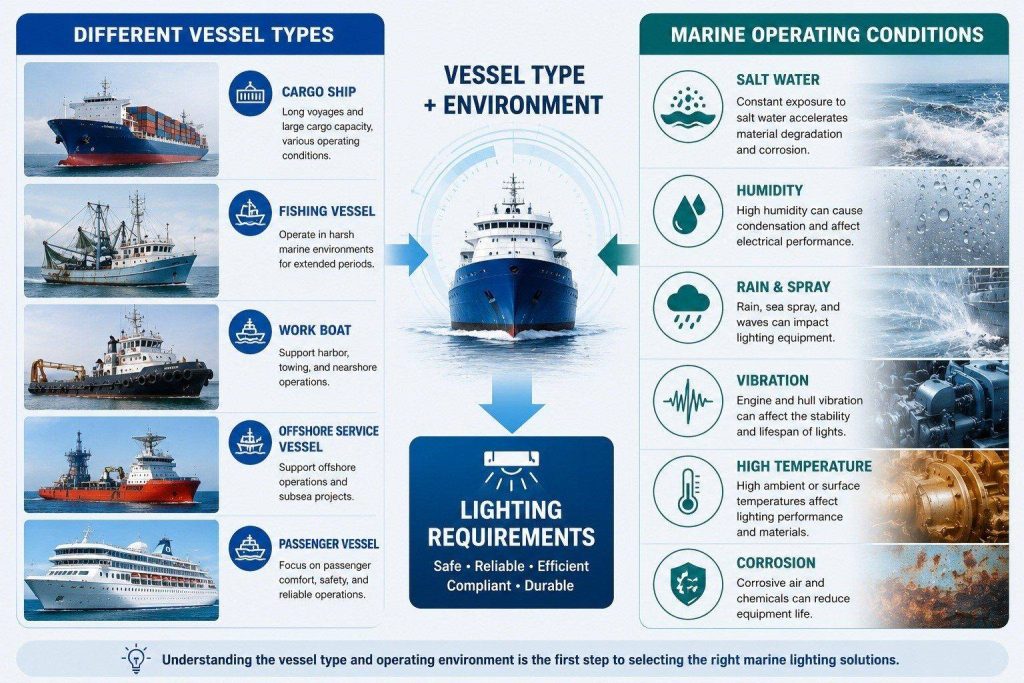
The first issue that must be addressed is the nature of the vessel being constructed and how it will be used. For example, cargo ships, fishing boats, work boats, offshore service vessels, passenger vessels, and other commercial vessels can all have different lighting needs.
The type of vessel will determine what types of lighting capabilities will be needed.
Consider the Operating Environment
Lighting in marine environments will be subjected to conditions which are not typical of other land-based systems. Factors such as salt water, humidity, vibration, temperature, environmental exposure, and corrosion may come into play.
Where will the vessel be operating? Are there locations that will experience seawater, rain, spray, high temperatures, or vibration? This information should be taken into account when choosing product specifications.
Identify the Main Lighting Applications
Once the vessel requirements are clear, create an initial list of lighting applications. Depending on the vessel, this may include:
- Navigation lights
- Searchlights and spotlights
- Deck and flood lighting
- Cabin and interior lighting
- Machinery-space lighting
- Emergency or special-purpose lighting
The objective at this stage is not to select specific models, but to establish what types of lighting the vessel actually requires.
Match Lighting With Different Vessel Areas
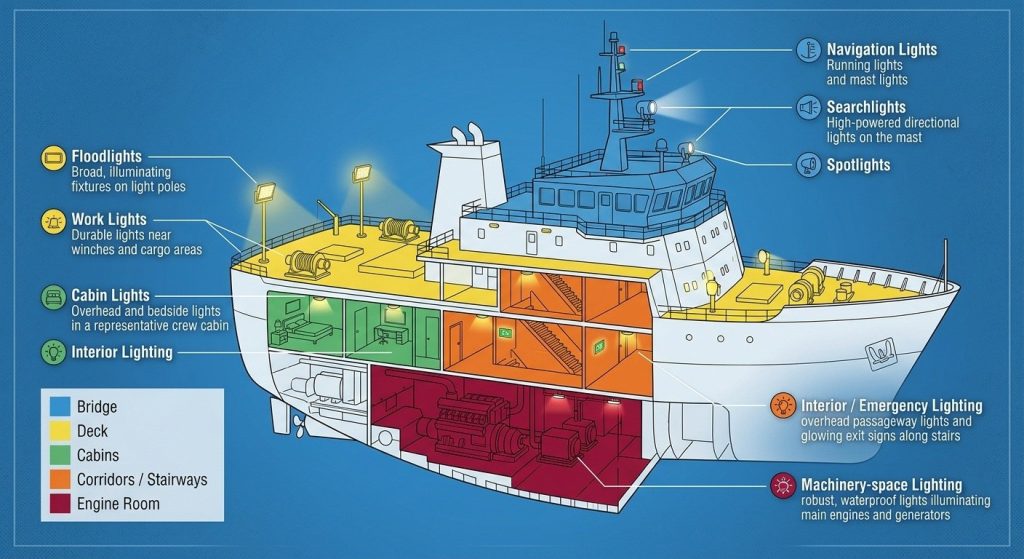
Navigation and Bridge Areas
Navigation lighting serves a different purpose from general illumination. Navigation lights provide required visual signals, while searchlights and spotlights may be used for observation, maneuvering, inspection, or nighttime operations.
Bridge-area lighting should also be considered in terms of visibility and glare, particularly during nighttime navigation.
Deck and Working Areas
Deck lighting should provide sufficient illumination for operations such as cargo handling, mooring, maintenance, and inspection.
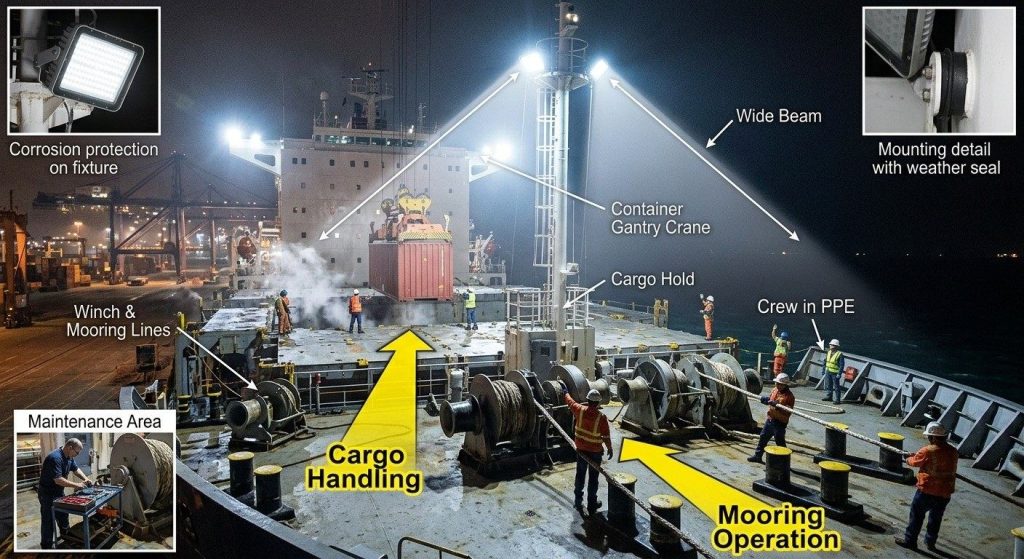
The installation location should be considered when selecting floodlights or other outdoor lighting. Mounting position, beam coverage, weather exposure, and protection against water and corrosion are important factors.
Engine Rooms and Machinery Spaces
Engine rooms and machinery areas may involve heat, vibration, oil, moisture, and limited installation space.
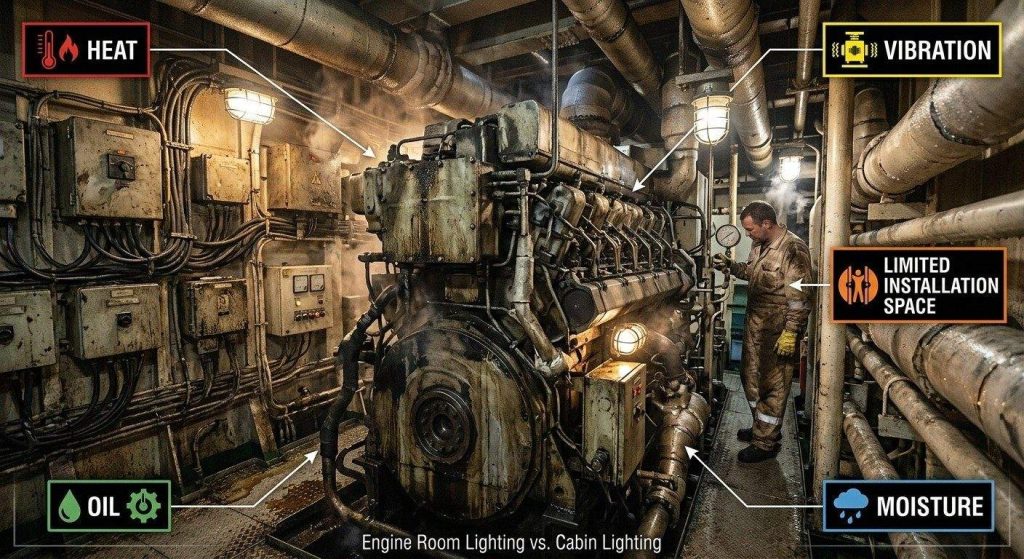
Lighting for these areas should therefore be selected according to the actual environmental conditions and maintenance requirements rather than using the same specifications as accommodation or general-purpose areas.
Cabins and Interior Spaces
Crew cabins, corridors, stairways, mess rooms, and other interior areas may require different lighting characteristics from outdoor working areas.
Factors such as installation method, power consumption, color temperature, size, and ease of maintenance can be considered when developing the interior lighting specification.
Establish the Technical Specifications
After identifying the required applications and installation areas, the next step is to create a technical specification list.
Key Specifications to Define
Depending on the application, the procurement specification may include:
- Rated voltage
- Power consumption
- Light output
- Beam angle
- Color temperature
- IP rating
- Housing material
- Mounting method
- Cable and connection requirements
- Operating temperature
- Dimensions and weight
- Control requirements
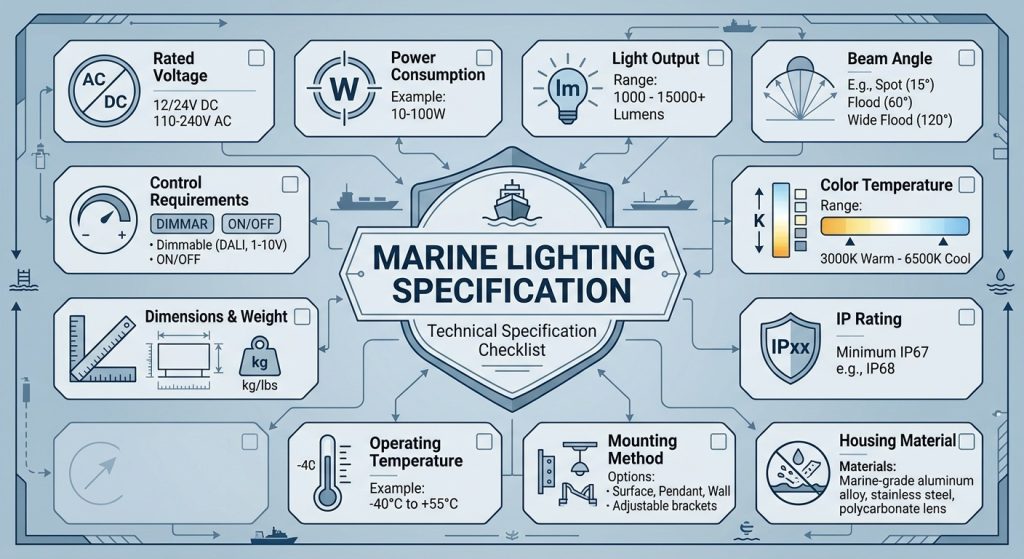
Not every parameter will apply to every lighting product. The specifications should be based on the vessel’s design, installation conditions, and operational requirements.
Check Installation Requirements
Physical installation should be considered at the same time as electrical specifications.
Confirm the available installation space, mounting position, cable routing, connection method, and accessibility for future inspection or maintenance. This can help prevent problems when the lighting equipment reaches the installation stage.
Confirm Certification and Documentation Requirements
Marine lighting requirements may vary by vessel type, flag state, classification society, operating environment, and project specifications. Confirm the applicable certification and documentation requirements before selecting products.
Depending on the project, buyers may need certificates, test reports, datasheets, drawings, or other technical documents. Reviewing these materials during supplier evaluation helps verify product suitability and avoid issues later. Certification should always be confirmed for the specific product and application, rather than assumed to apply to an entire product range.
Evaluate Marine Lighting Suppliers
Look Beyond Unit Price
For a new vessel project, the lowest quoted unit price is not necessarily the most relevant comparison.
Procurement teams should also consider product quality, technical support, manufacturing capability, documentation, customization options, production capacity, packaging, and delivery requirements.
Consider Direct Manufacturer Supply
Buying directly from a manufacturer can reduce the number of intermediaries involved in communication and procurement.
More direct communication can be particularly useful when the project requires customized specifications, multiple lighting categories, special packaging, or technical clarification during production.
Check Product Range and Project Capability
A supplier offering several marine lighting categories may simplify procurement for projects requiring different types of equipment.
For example, a marine lighting supplier may provide navigation lights, searchlights, spotlights, floodlights, cabin lighting, and other application-specific products. Having multiple categories available from one manufacturing source can reduce the need to coordinate specifications and delivery with several separate suppliers.
Prepare a Clear RFQ
Before requesting quotations, provide as much project information as practical. A marine lighting RFQ can include:
- Vessel type
- Number of vessels
- Required lighting categories
- Estimated quantities
- Technical specifications
- Installation requirements
- Certification requirements
- Delivery location
- Required delivery schedule
If available, include equipment lists, drawings, lighting layouts, or existing technical specifications.
Plan Procurement Before Selecting Products
Marine lighting procurement is easier to manage when it is treated as part of the vessel project rather than as a collection of individual product purchases.
Start by identifying the vessel type and operating environment. Then determine the lighting applications, match them to different vessel areas, establish the technical specifications, confirm certification and documentation requirements, and evaluate suppliers based on both products and manufacturing capabilities.
For projects requiring multiple marine lighting categories, working directly with an experienced manufacturer can also simplify technical communication and procurement coordination.
When the project requirements are ready, providing the vessel type, quantities, technical specifications, and delivery requirements to a qualified marine lighting manufacturer is a practical next step toward obtaining a project-specific quotation.
